Q1 W6 - 7
10.13.25 - 10.26.25
Completed
- Revisited layout and design of pyramids, increasing the size/scale to be more dramatic
- Updated previz accordingly, aiming to maintain similar cinematography
To Do
- Finish modeling for updated ending, adjust previz accordingly
Previz Updates
Old
New





Updated Pyramid Layout
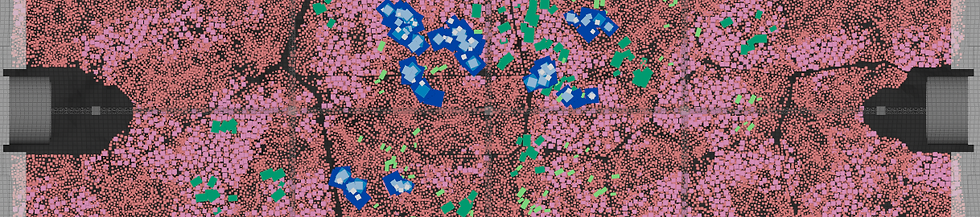
Through blocking out the previous pyramid designs in 3D space, then later making changes within 3D space to further develop the previz, I began to find difficulty in justifying certain design elements, as well as flaws in realism or real-world physics that would apply to the design. This week, I made some changes to the layout.


Modeling Process


Reasoning - Physics, Psychology, Logistics
In the previous pyramid designs, agricultural towers encasing vines were arranged in the middle of the pyramid, leaving the city and general population on the outskirts. This, inherently, creates a few psychological issues in regards to architecture, as well as leaves the pyramid's physical support or foundation unjustified.
Previously, the outer edges of the pyramid were inhabited by this world's population, a population which is already facing oppression both by living effectively in a hole, as well as having no mobility on the surface of Earth. If the vines were to comparatively have more upward mobility by towering over the civilization, in addition to having more access to natural sunlight that seeps through the ceiling, I could infer that these metal frames would be overrun by angry civilians seeking a better living situation and proximity to sunlight and their food source. This would create vulnerability in the agricultural system, which is the lifeline of the pyramid cities, as people's frequent traffic could jeopardize the health of the system.
Placing the city in the center, therefore, not only physically traps and oppresses in a similar sense, but gives the illusion of dominance over nature and a feeling of protection. The towers of vines still stand significantly taller than the highest towers of the city, however being on the outskirts, they act as a wall rather than a nuisance taking up natural sunlight. This also reveals another important point, in which the city now has an illusion of freedom that may contribute to the city's overall stability, having more access to natural light and a ceiling that extends substantially higher than their tallest buildings. The American saying "the sky is the limit" hides some truth in human psychology; if the 'limit' isn't maximally constricting, I would infer that these civilians would be less likely to claw at the walls trying to escape. Plus, they all would be aware of the state of the Earth, so their current cities would be the only viable place to be.
Another aspect I wanted to revisit was the scale, as I felt that the previous size of the pyramids was not quite dramatic or impactful enough for my liking. If I wanted to increase the scale, there could then be a larger city and increased amount of vine towers. I was debating whether or not to revisit the actual vine towers and potentially increasing their size/shape, however I opted against this. If, theoretically, there was a sickness or disease the vines faced, the disease could be more easily controlled if the vines were confined in their own protected towers. This would help to ensure high levels of production and lower the risks of famine.
Oxygen
Lastly, an element that I wanted to include within the pyramid are large fans that help circulate oxygen produced by the vine towers. This was an interesting element to explore, in terms of keeping oxygen within the pyramids, and keeping CO2 outside as much as possible, allowing air flow in and out in a controlled manner.
Oxygen is lighter, being about 32 g/mol in density, CO2 standing at 44 g/mol; therefore CO2 in a vacuum would sink underneath oxygen. This is a potential problem, as we don't want CO2 to seep into the pyramids too much, or to effectively suffocate the population with oxygen deprivation.
Therefore, with any flow of air movement, we would desire the motion to be upward and out, which can be done with temperature control (maintaining a cooler temperature inside than outside) and a slight amount of circulation of air that keeps positive pressure inside. This brings more realistic purpose to the fans than just an interesting 'scifi' element.
If on this planet, the nights are on the opposite extremes of temperature, going from extremely hot to cold as the sun sets, there would likely need to be a roof that closes at night to keep CO2 from seeping in at higher levels. I may revisit some kind of mechanism to open and close the roof, although I may neglect this aspect for the moment.
Extra References